


When it comes to Luminescent Solar Concentrators (LSC), advanced anti-counterfeiting inks, and high-heat specialty plastics, BASF’s Lumogen® F Red 305 has long been the industry’s default standard. But its heavy price tag and rigid supply chain requirements often bottleneck formulation design. In this technical breakdown, we look closely at the molecular structure, photophysics, and field performance of its structural twin—Perylene Pigment Red 311 (CAS: 112100-07-9). It serves as a seamless, drop-in replacement that retains maximum optical purity and fluorescence quantum yield (ΦF) while slashing raw material costs by up to 30–50%.
1. The Formulation Bottleneck: Finding a Fluorescent Red That Doesn’t Compromise
Engineers working in high-end polymer coloration and optoelectronics operate under brutal constraints. They need a fluorescent dye that delivers on three uncompromising fronts:
- Extreme Heat Survivability: The dye cannot thermally degrade during the 300°C extrusion processing of engineering plastics like PC or PMMA.
- Weathering & UV Resistance: It must maintain a brilliant, glowing hue under years of broad-spectrum UV exposure in outdoor panels.
- High Fluorescence Quantum Yield (ΦF): It needs to achieve near-perfect energy transfer even at low doping concentrations.
Historically, formulators default to Lumogen® Red 305 to solve this. However, the Topwell lab team is increasingly fielding the same question from R&D directors: “Is there an exact chemical match out there that doesn’t break the budget or require massive minimum order quantities?”
The short answer is yes. It’s called Perylene Pigment Red 311 (PR 311).
2. Under the Hood: Why PR 311 is a True Drop-in Replacement
Chemically speaking, Topwell’s PR 311 shares the exact same CAS registry (112100-07-9) and molecular footprint as Lumogen Red 305 (N,N-Bis(2,6-diisopropylphenyl)-1,6,7,12-tetraphenoxyperylene-3,4:9,10-Tetracarboxdiimide). What this means for your R&D team is that shifting to this alternative requires practically zero adjustments to your current solvent systems or resin matrices.
Let’s look at the hard data out of our testing labs:
Spectral Match & Purity
PR 311 exhibits an intense red absorption profile. In ethylene dichloride, its absorption maximum(λmax) hits 575±2 nm, driving a deep Stokes shift with a sharp emission peak at ~613 nm. Because impurities cause optical quenching, Topwell processes this pigment into two distinct grades:
- Standard Grade (Purity ≥92%): The workhorse for general thermoplastic compounding and security printed inks.
- Optical Grade (HPLC Purity ≥95%): Extensively refined for LSCs and OLEDs, stripping out the trace impurities that kill quantum yield.
Thermal Stability
TGA (Thermogravimetric Analysis) and real-world injection molding tests confirm a melting point of ≥300°C. Even when processed in polycarbonate or selected fluoropolymers, the pigment structure remains fully intact with negligible color shift (ΔE≤1.0).
3. Top Three Frontier Applications for PR 311
Formulators are currently sourcing PR 311 for these high-value applications:
1. Luminescent Solar Concentrators (LSC) & BIPV
This is where PR 311 shines. Doped into a transparent PMMA waveguide, the dye absorbs ambient visible light and channels a 613 nm red emission toward the edges to hit photovoltaic cells. Its exceptional photostability is what makes 20-year lifespans possible for solar greenhouses and building-integrated photovoltaics.
2. High-Security & Anti-Counterfeiting Inks
Because of its incredibly sharp, distinct emission peak, PR 311 acts as a highly reliable machine-readable “fingerprint.” Under UV blacklight, it fluoresces a blinding red, making it a staple for banknote printing, tax stamps, and brand authentication markups.
3. Organic Electronics (OLEDs & OPVs)
In the lab, materials scientists utilize its stability as an n-type organic semiconductor. It frequently serves as the red emissive layer in OLEDs or as the electron acceptor material in organic solar cells.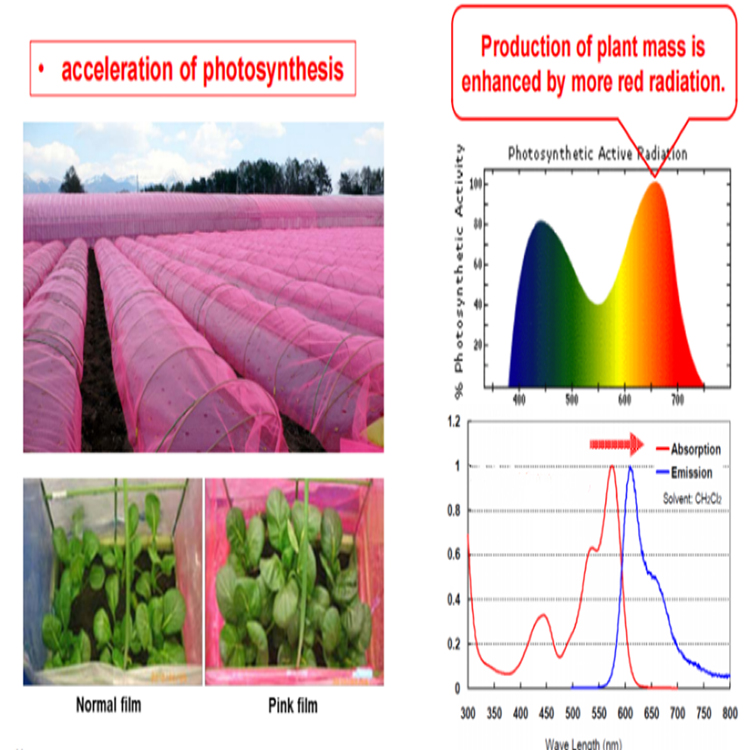
4. The Procurement Angle: Beyond Just Cost Savings
Approving Topwell’s PR 311 isn’t solely a technical win; it’s a strategic procurement advantage:
- Direct Cost Reduction: Formulators routinely report cutting material costs by 30% to 50% without giving up a single percentage point of optical performance, simply by bypassing the brand premium.
- R&D-Friendly Supply Chain: Forget the headaches of dealing with multinational conglomerates and their rigid MOQs. We support everything from a 10-gram feasibility test run up to multi-ton commercial scaling.
- Strict QC Documentation: We back every batch with the paper trail you need for compliance, including HPLC purity profiles, spectral data, and full COA/TDS/SDS sets.
5. Final Takeaway from Our Engineering Team
If you are currently relying on Lumogen® F Red 305, or if your latest formulation is battling fading issues, thermal degradation, or budget overruns, testing an isomeric equivalent is the most logical next step.
Whether you are pushing the limits of agricultural solar films or developing the next generation of security inks, validating compatibility is straightforward.
Ready to evaluate PR 311 in your own matrix?
Click here to view full product specs, download the TDS, and order a 10g–50g lab testing sample. Our chemical sales team will process your R&D requirement within 24 hours.
Post time: Sep-11-2026